


Russian Manicure can be performed with a conservative professional approach, but the name itself is not a safety standard. The meaningful questions are what tissue is being worked on, how the tools are controlled, whether the service suits the client and how instruments are processed between appointments.
01Is Russian Manicure safe?
The balanced answer is: it can be performed more or less safely, but it is not risk-free. A Russian Manicure involves detailed dry preparation close to delicate living tissue. The outcome depends on assessment, training, pressure and angle control, appropriate tool selection, hygienic practice and the technician's willingness to stop.
The term is also used inconsistently. One salon may mean conservative dry preparation of non-living material on the nail plate; another may advertise complete removal of tissue around the nail. Those are not equivalent services. A label, close-up photograph or high price cannot tell a client which approach will be used.
For a broader explanation of the method, start with What Is a Russian Manicure?
02Why nail anatomy matters
The nail is not only a hard plate. The proximal nail fold, surrounding skin, cuticle and underlying nail-forming structures work together as a functional unit. The cuticle is keratinized material that adheres to the nail plate and helps form a seal at the base of the nail.
Salon language often uses “cuticle” for every visible structure around the nail. That creates confusion between non-living material on the plate and living tissue surrounding it. Technical vocabulary can improve precision, but it does not cancel the need for conservative practice.
The CDC states that cuticles act as barriers to infection and advises against cutting them. The American Academy of Dermatology similarly advises consumers not to cut or forcefully push them back.
03What are the potential risks?
Possible harms include irritation, cuts, inflammation, thermal discomfort, over-filing of the nail plate and increased opportunity for infection when the protective barrier is disrupted. The risk is not created by one tool alone; it emerges from the interaction between tissue condition, technique, equipment and hygiene.
| Risk | How it may happen | What the client may notice |
|---|---|---|
| Skin trauma | Working too deeply, cutting living tissue or repeating passes over one area | Sharp pain, bleeding, rawness or persistent tenderness |
| Heat injury | Excess pressure, a worn or clogged bit, or holding the bit too long in one place | Burning or concentrated heat during the service |
| Nail-plate damage | Over-filing the natural nail or using unsuitable abrasives and angles | Thinness, sensitivity, grooves or breakage |
| Inflammation or infection | Barrier disruption, contact with blood, contaminated tools or work over already compromised skin | Increasing redness, swelling, warmth, pain or discharge |
| Allergic reaction | Uncured nail product contacting skin or sensitization to product ingredients | Itching, swelling, rash, blistering or nail separation |
A published dermatology case report described acute paronychia followed by nail shedding after aggressive cuticle removal during a Russian Manicure. One case cannot measure how often a complication occurs, but it demonstrates that serious harm is possible when the protective area is disrupted.
04What does safer professional practice look like?
Safety is a system rather than a single setting on an e-file. A responsible appointment connects client screening, technical control, infection prevention and product application.
-
Assessment before action
The technician observes the nail plate and surrounding skin, asks relevant questions and changes or postpones the service when necessary.
-
Purpose-selected tools
Bits and hand tools are chosen for a defined task and the client's condition, not used as a memorized universal sequence.
-
Controlled movement
The working hand remains supported, the bit keeps moving and pressure stays light enough that the tool glides rather than digs.
-
Clear stop points
Pain, burning, unexpected bleeding or unstable tissue trigger an immediate pause and reassessment.
-
Complete instrument processing
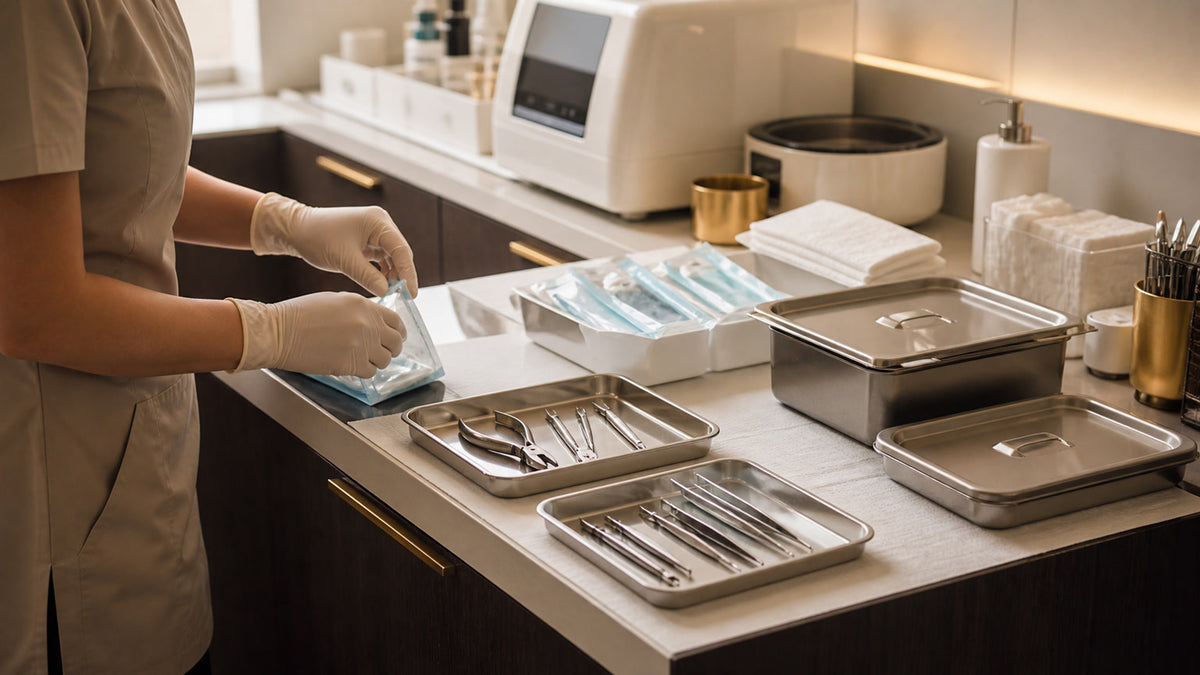
Reusable tools are cleaned before the required disinfection or sterilization process, single-use items are discarded and processed tools are stored cleanly.
05When should the service be postponed?
A nail technician should not diagnose or treat disease. The professional decision is whether cosmetic work should proceed and when a client should be referred for appropriate medical assessment.
Sensitivity without active injury
Thin nails, dry skin or a history of irritation may call for a reduced scope, different tools or a gentler service.
Active or unexplained changes
Open wounds, bleeding, marked redness, swelling, discharge, blisters, significant pain or unexplained nail separation require postponement and, when appropriate, medical evaluation.
Clients with diabetes, neuropathy, impaired circulation, immune conditions or other health concerns may need individualized advice from a healthcare professional. A generic internet checklist cannot replace that assessment.
06What should a client ask before booking?
- What specialized dry-manicure and e-file education has the technician completed?
- Is the technician appropriately licensed where licensing is required?
- How are reusable bits and metal instruments cleaned and processed between clients?
- Which abrasives and other items are single-use?
- How is the service modified for sensitive skin, thin nails or previous damage?
- What does the technician do if there is pain, bleeding, inflammation or a suspicious nail change?
OSHA advises avoiding clients with cuts, open wounds, blisters or visibly infected skin and describes cleaning and disinfecting reusable tools according to state cosmetology-board requirements. Local rules vary, so a salon should be able to explain the process that applies in its jurisdiction.
07Aftercare and warning signs
After a comfortable service, the surrounding area should not feel raw or progressively painful. Keep the skin moisturized, avoid picking at the coating or surrounding tissue and do not use household tools to “correct” the perimeter.
The safest outcome is not the deepest-looking manicure. It is a precise result produced without unnecessary trauma, supported by transparent hygiene and followed by healthy recovery between appointments.
To understand the service in practical context, compare Russian Manicure with a regular manicure, follow the appointment process step by step, and review the guide to retention, aftercare and choosing a technician.
Safety becomes easier to evaluate when the entire service is understood as one system. Review the complete professional guide to Russian Manicure, then use the professional training checklist to assess how a course teaches control and stopping criteria.

08Sources and further reading
This article is educational and does not provide medical, legal or licensing advice. Requirements vary by jurisdiction and can change. Nail technicians do not diagnose or treat disease; concerning nail or skin changes should be evaluated by an appropriately licensed healthcare professional. Practitioner observations are informed by Nailspiracy's Russian Manicure 360 curriculum and are presented separately from independent medical and public-health sources. Reviewed August 2026.