


Russian Manicure is best understood as a connected professional service system. Its result depends on assessment, hygiene, controlled cuticle and nail-plate work, product selection, curing, architecture and aftercare. The name of the technique does not guarantee safety or quality; professional judgment at every stage does.
01What Russian Manicure is
Russian Manicure is a dry, precision-focused manicure approach that commonly combines an e-file with manual tools to prepare the nail folds and plate for a clean coating application. The full professional service extends beyond cuticle removal. It includes the decisions that protect the natural nail, control product placement and create balanced structure.
For a concise introduction, read What Is a Russian Manicure?. For a method comparison, see Russian Manicure vs. Regular Manicure.
How this guide was developed
This guide reflects the same research model used to develop Russian Manicure 360. Siranush Ambartsumian combined salon experience, years of teaching, model-based observation and the recurring technical problems brought by students with broader study of anatomy, nail technology, product systems and professional literature.
Milady Standard Nail Technology, 7th Edition was one of the supplementary educational references used during that process. Its chapters on infection control, anatomy, skin and nail structure, disorders and diseases, chemistry, electric filing, manicuring, and UV and LED gels provide general nail-technology context. The specialized Russian Manicure decisions in this guide come from Siranush's documented methodology and practical teaching system, while independent health and safety claims are checked against current authoritative sources.
Milady's seventh edition is not treated here as a current legal or medical authority. Requirements vary by jurisdiction and technical standards change. It is cited transparently as one part of the educational background, not as the source of every claim or as a substitute for current regulation, medical guidance or manufacturer documentation.
02Anatomy defines the working boundary
The proximal nail fold protects structures involved in nail growth. The nail plate rests over the nail bed, while keratinized material can adhere to the plate and collect around the folds. Salon terminology is not always consistent, especially around cuticle and eponychium, so professional education should define exactly which visible material is being discussed.
The practical boundary matters more than vocabulary: technicians work only within their professional scope and do not intentionally cut living tissue. Visibility, tissue response and client sensation matter. If the contact point cannot be seen, or tissue reacts with pain or bleeding, the correct response is to stop and reassess.
03The complete professional service system
-
Consult and assess
Review service history, visible condition, sensitivities and reasons to modify or postpone.
-
Prepare the workspace
Use processed reusable tools, appropriate single-use items, dust control and clean working surfaces according to applicable requirements.
-
Remove previous product
Identify the product and preserve a controlled substrate rather than filing without a visible endpoint.
-
Perform cuticle work
Select e-file and manual methods by tissue condition, visibility and trained technique.
-
Prepare the nail plate
Create only the surface required by the chosen coating system while preserving natural thickness.
-
Apply and cure product
Control skin contact, layer thickness, compatibility and lamp requirements.
-
Build and verify architecture
Balance length, apex, sidewalls, free edge and the forces expected during wear.
The detailed Russian Manicure process guide follows these stages from appointment to finish.
04Assessment determines the technique
| Observe | Decision it affects |
|---|---|
| Skin hydration and attachment | Tool profile, abrasive, movement and whether cutting is appropriate. |
| Nail thickness and flexibility | Removal endpoint, preparation method and coating system. |
| Previous lifting or damage | Cause analysis, repair scope and whether to reduce the service. |
| Pain, inflammation or unexplained changes | Whether to stop, postpone or recommend appropriate evaluation. |
| Length and lifestyle | Architecture, product flexibility and maintenance plan. |
A technician does not diagnose disease. The purpose of assessment is to recognize the professional service boundary and choose a responsible next step.
05Removal and shaping begin the technical sequence
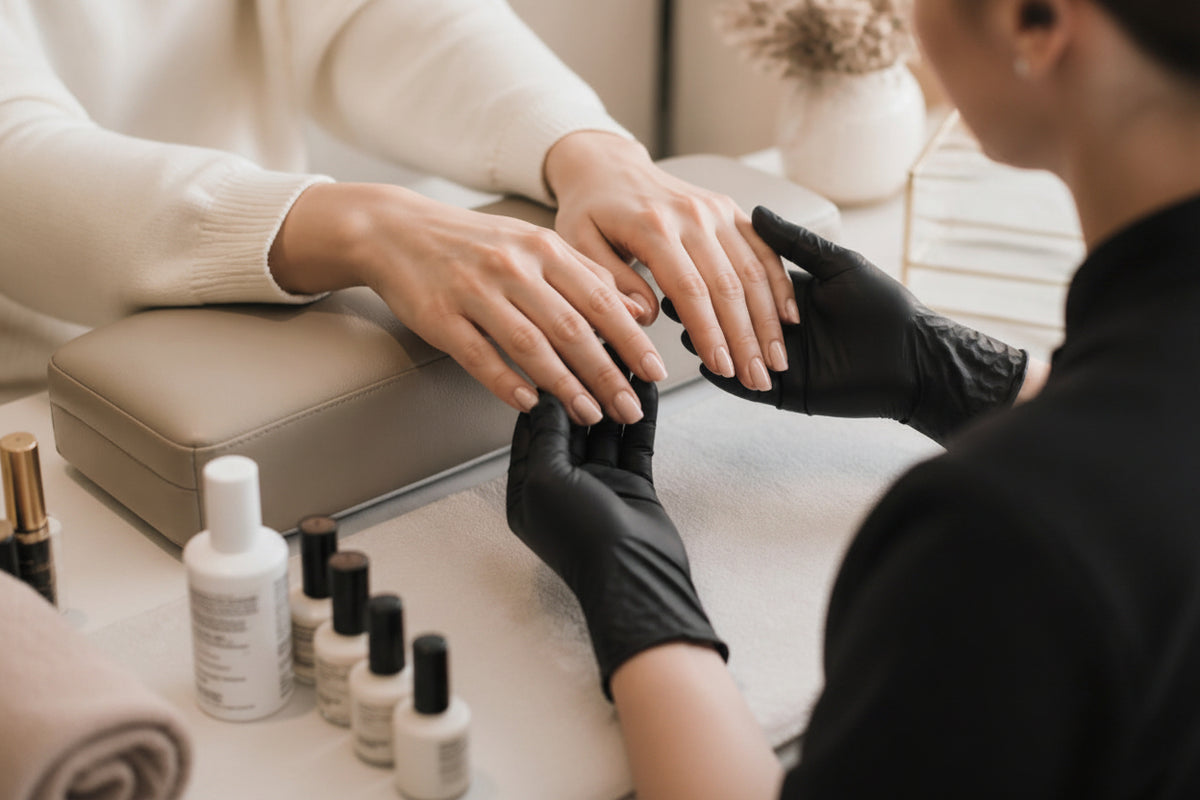
Old product removal is not one uninterrupted filing action. The technician identifies material, thickness, lifted areas and structure that may remain. The contact point stays supported and visible. Localized lifting is isolated rather than chased across sound product, and the natural plate is not used as a depth indicator.
Siranush's RM360 demonstrations organize removal into a repeatable sequence and show the errors that interrupt control: staying in one place, forcing an unsuitable bit, losing the working angle, using pressure to compensate for inefficient contact and continuing after the intended layer is removed.
Shaping establishes proportion before coating. Oval, square and almond require different sidewall, free-edge and axis decisions. Symmetry does not mean filing every nail identically. It means adapting the plan so the finished set reads as one balanced system.
06Tools do not replace control
Bit material, shape, diameter and abrasive level influence access and efficiency, but the operator still controls stabilization, direction, angle, pressure, speed, contact time and repeated passes. A common tool can be inappropriate when the task or tissue changes.
Choose by popularity
Copy a bit and speed from a video without matching the material, anatomy or task.
Choose by function
Define what must be removed, where contact occurs and what endpoint protects the client.
Use the professional tools checklist and the guide to e-file bit shapes, grits and uses for task-level selection.
07Cuticle work is a sequence of controlled decisions
A pusher can help assess attachment and create access, but forcing it beneath resistant tissue can cause trauma before the e-file stage. A flame-shaped diamond bit may be selected for detailed fold work, yet diameter, abrasive level and tip profile change how it enters and contacts the working area.
Angle is dynamic. The technician changes hand position to maintain controlled contact rather than twisting the client's finger into a poor position or allowing the tip to catch. Pressure remains light enough to preserve feedback. The bit should work through suitable movement and abrasive contact, not force.
Scissors and nippers are choices, not mandatory symbols of Russian Manicure. Tissue condition, access, intended cut and validated skill determine whether either is appropriate. Siranush's nipper sequence uses a light test contact before committing: assess entry depth, observe the client's reaction, adjust angle if needed and proceed only when the position is controlled.
08Safety, hygiene and stopping rules
Professional safety begins before the tool touches the client. Reusable instruments need a validated processing workflow appropriate to their classification and the applicable jurisdiction. Single-use items must not be reused. Product labels, safety information and curing instructions remain part of the service system.
- Do not treat pain, heat or bleeding as normal signs of thorough work.
- Keep the working point visible and supported.
- Stop mechanical preparation when grooves, localized redness or unexpected sensitivity appears.
- Avoid product contact with skin and follow the coating and lamp manufacturer’s instructions.
- Modify or postpone when the visible condition falls outside the technician’s service scope.
Read the full evidence-led discussion in Is Russian Manicure Safe?.
09Preparation, product behavior and architecture
Preparation should remove the residue, contamination or surface condition specified by the coating system. It should not erase every natural ridge or continue until the plate has a manufactured matte appearance. When lifting repeats, Siranush's curriculum treats it as a system problem involving placement, dust control, product flexibility, thickness, architecture, lamp compatibility, curing and client wear.
| Variable | Professional question | Risk when ignored |
|---|---|---|
| Flexibility | Does the coating move appropriately with this nail and length? | Lifting, cracking or unstable structure. |
| Viscosity | Can placement be controlled before the product moves? | Flooding, uneven surface or excess bulk. |
| Thickness | Is the layer within curing instructions? | Incomplete cure, heat or weakness. |
| Lamp compatibility | What lamp and exposure does the manufacturer specify? | Unreliable polymerization despite a hard-looking surface. |
| Architecture | Are apex, sidewalls, free edge and axis balanced? | Stress concentration, breakage or uneven reflection. |
RM360 progresses from base systems to hard-gel structuring and complex correction. The authorial principle is consistent: product application is material behavior plus geometry, not brush choreography alone.
10What professional quality looks like
A high-quality result is clean without visible trauma, proportionate to the natural nail, fully cured within the product system and appropriate for the client’s wear. The client should understand maintenance and aftercare.
Use the guides to prepare without over-filing, correct common Russian Manicure mistakes and plan aftercare and maintenance.
The client experience is part of quality
A precise result does not excuse poor communication. Before the service, the technician should explain the planned scope, ask about relevant history and set expectations for length, shape and maintenance. During the service, the client must be able to report heat, pulling or pain without being told that discomfort is necessary for a clean result.
Aftercare is equally practical. Clients should avoid using nails as tools, protect the coating from unnecessary impact and return within a maintenance interval appropriate to growth, structure and wear. Changes such as persistent pain, separation, discoloration or inflammation are not home-maintenance problems to cover with another coating.
Siranush's service logic connects the finished photograph to everything that happened before it. A clean cuticle line, balanced reflection and durable structure are evidence of controlled steps only when the natural nail and surrounding tissue were respected throughout the appointment.
An observable professional standard
A technician should be able to explain the service without relying on the reputation of the term Russian Manicure. The tools are processed appropriately. Single-use items are new. The plan changes when the nail or tissue requires it. Contact stays controlled and visible. Product does not intentionally touch skin. Curing follows the product system. Architecture supports the intended length. The client receives maintenance guidance.
This standard also creates a useful boundary for education. Students should not graduate from copying one model to calling every result a Russian Manicure. They should learn how to assess, select, execute, inspect and correct. That connected sequence is the central authorial idea behind Russian Manicure 360 and the reason Nailspiracy treats the technique as a full professional system.
11Troubleshooting the complete system
Professional troubleshooting starts with location and timing. A cuticle-zone lift points to different questions than a free-edge crack. Heat during removal has different causes from heat during curing. A groove made during preparation is not corrected by automatically covering it with more product.
- If the e-file feels hot: stop and review pressure, contact time, bit condition, speed and material efficiency.
- If tissue is irritated: stop cuticle work, document what occurred and do not normalize the reaction.
- If product floods: review amount, viscosity, leveling time, brush control and hand position.
- If lifting repeats: map its location and review preparation, contamination, compatibility, structure, curing and wear.
- If reflection is uneven: evaluate architecture and leveling rather than repeatedly filing the natural plate.
This cause-led approach is one of the strongest themes in Siranush's curriculum. A correction is professional only when it addresses the variable that produced the result.
12Common Russian Manicure myths
| Myth | Professional correction |
|---|---|
| Deeper always means cleaner | Depth is limited by anatomy, tissue condition, visibility and client response. More removal is not automatically more precise. |
| One flame bit works for everyone | Profile, diameter and abrasive are selected for the task and access. Operator control remains essential. |
| Bleeding is normal while learning | Bleeding is an injury signal. Stop, follow the appropriate incident protocol and correct the technique. |
| More filing prevents lifting | Retention also depends on contamination control, product compatibility, placement, curing, architecture and wear. |
| A close application creates the premium result | Cuticle-zone precision matters, but symmetry, architecture, surface reflection, sidewalls and free-edge refinement complete the result. |
| A certificate proves mastery | A certificate records course completion. Competence develops through correct practice, assessment, feedback and responsible work within local requirements. |
13Training should teach the why behind the sequence
A course should connect anatomy, hygiene, tools, preparation, product behavior, curing, architecture and troubleshooting. It should also provide a method for practical feedback and state the limits of its certificate.
The Russian Manicure training guide provides a complete evaluation checklist.

For professional salon services, finished results and signature nail art, visit Nail Art Department in Hallandale Beach, Florida.
14Sources and further reading
- OSHA: Health Hazards in Nail Salons
- OSHA: Biological Hazards
- CDC: Nail Hygiene
- American Academy of Dermatology: Healthy Nail Care
- FDA: Nail Care Products
- Milady Standard Nail Technology, 7th Edition, supplementary professional-education reference.
This article is educational and does not replace professional training, local requirements, manufacturer instructions or medical advice. Nail technicians should not diagnose or treat nail disease. Practitioner methodology is informed by Nailspiracy's Russian Manicure 360 curriculum and is separated from independent health sources. Reviewed August 2026.