


A Russian Manicure is best understood as a precise dry-preparation system - not as a promise of a particular look, a universally safe procedure or a single sequence that should be performed on every client.
01What is a Russian Manicure?
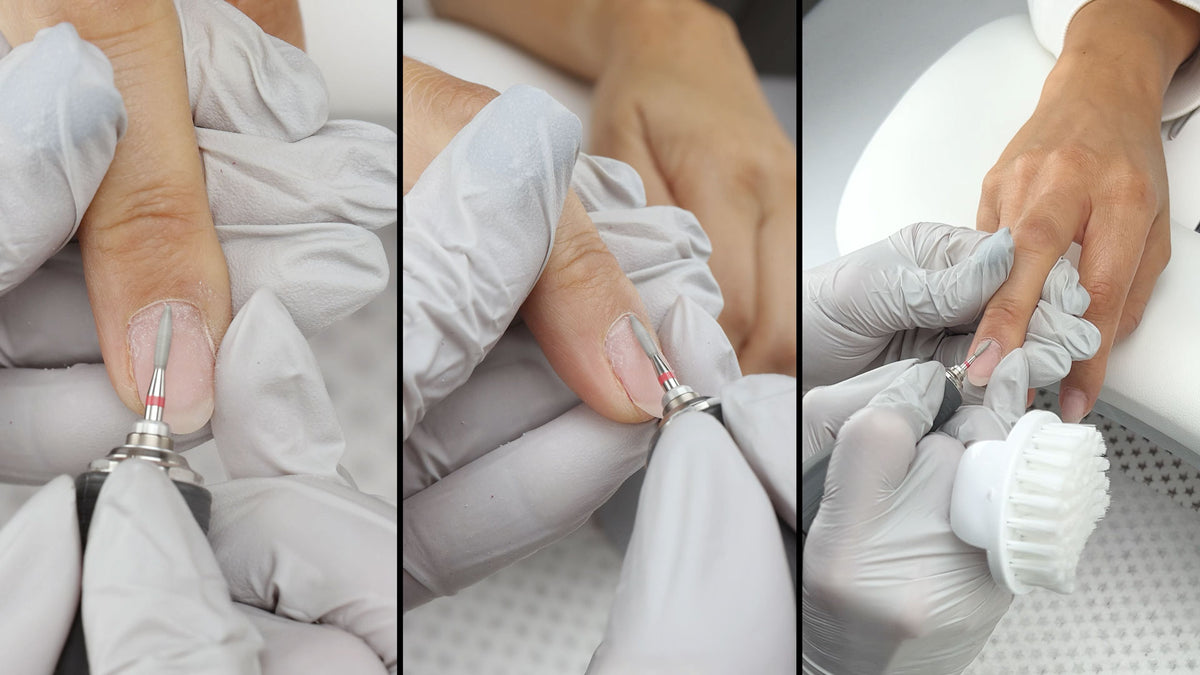
A Russian Manicure is a detailed dry manicure system that commonly combines an electric file, purpose-selected bits and professional hand tools to prepare the natural nail and surrounding area before product application. It is also described as an e-file manicure, dry manicure or combined manicure.
The aim is to create a controlled foundation for gel polish, structured gel, builder gel or another nail coating. Unlike a traditional manicure that may use water to soften the surrounding skin, this method is generally performed dry. A dry surface can help the technician see the nail plate and surrounding tissue clearly and adjust the service to the individual client.
The label does not guarantee a particular method or level of training. Tool choice, product choice and the amount of work appropriate around the nail depend on the client's nail and skin condition, the planned coating, applicable licensing rules and the technician's education.
Why is it called a Russian Manicure?
Outside Eastern Europe and the former Soviet region, “Russian Manicure” became a common English-language label for the detailed dry and combined methods associated with Russian-speaking nail education. Today, clients often use the term as shorthand for a highly precise style of preparation rather than as a verified claim of one inventor or one national origin.
Because the historical development of the English-language term is not well documented in authoritative sources, it is more accurate to describe the technique and its training traditions than to assign it to a single person or country.
02Russian Manicure vs. regular manicure
The clearest differences are the dry working method, the level of detail around the nail and the frequent use of an e-file. The exact distinction still varies by salon and technician.
Regular manicure
The surrounding area may be softened, gently pushed back and trimmed where permitted. The appointment is often shorter and may involve fewer specialized tools.
Russian Manicure
The technician generally works dry and may use several purpose-selected bits and hand tools to refine preparation before applying the coating.
Why can the finished manicure look cleaner?
A carefully prepared perimeter can help a trained technician apply coating in a controlled line close to, but not on, the surrounding skin. As the nail grows, that deliberate starting point may make the grow-out look more even.
The final appearance does not come from cuticle work alone. Nail shape, product control, apex and structure, complete curing, color application and finishing all contribute to a clean result.
Can it improve retention?
Nail preparation is one factor in adhesion. Material left on the nail plate, dust, surface contamination or incompatible preparation can contribute to lifting. Thorough professional preparation may create a cleaner application surface, but it cannot guarantee longer wear.
Retention also depends on the natural nail, product compatibility, structure, application thickness, curing, client habits, chemical exposure and aftercare. An expensive product cannot compensate for poor preparation; detailed preparation cannot compensate for incorrect application or curing.
03What happens during an appointment?
A professional appointment should begin with assessment - not with an automatic sequence copied from a short video.
-
Consultation and assessment
The technician reviews the client's goals and observes the nail plate and surrounding skin for conditions that may require a gentler service, modification or postponement.
-
Removal and shaping
Previous coating is removed when appropriate, and the natural nail is shaped with controlled pressure.
-
Dry preparation
The technician uses selected e-file bits and/or hand tools according to the nail and skin condition rather than treating every client identically.
-
Product application
Gel polish, builder gel or another coating is applied without placing uncured product on the skin and is cured according to the product system.
-
Finish and aftercare
The technician checks the structure and finish, then explains maintenance and what changes should prompt professional or medical attention.
04Cuticle, eponychium and proximal nail fold
Many disagreements about Russian Manicure begin with inconsistent terminology. In clinical nail anatomy, the cuticle is produced by the eponychium at the underside of the proximal nail fold and adheres to the proximal nail plate. Together, these structures contribute to a seal that helps limit pathogen entry.
In everyday salon language, people often call all visible skin at the base of the nail “the cuticle.” That can obscure the difference between non-living keratinized material on the nail plate and living tissue around the nail.
The distinction matters, but it should not be used to dismiss medical guidance. The CDC advises against cutting cuticles because they act as barriers to infection. The American Academy of Dermatology similarly advises consumers not to cut or forcefully push them back.
05Is Russian Manicure safe?
No manicure technique is automatically safe because of its name. Russian Manicure involves detailed work close to delicate living tissue. Risk depends on client screening, technician education, pressure and angle control, infection-control procedures, the condition of the nail unit and compliance with applicable rules.
Potential harms from incorrect or overly aggressive work include cuts, irritation, inflammation, over-filing, nail-plate damage and increased opportunity for infection when the protective barrier is disrupted. A published dermatology case report has described acute paronychia and nail shedding after aggressive cuticle removal during a Russian Manicure.
| Observation | Appropriate response |
|---|---|
| Healthy nail and intact surrounding skin | Proceed only within the technician's training, scope and local requirements. |
| Sensitive, thin or recently irritated skin | Reduce the scope, modify the technique or choose a gentler service. |
| Open wound, active bleeding or blister | Do not work over the affected area; postpone the service. |
| Redness, swelling, persistent pain or suspected infection | Do not diagnose or treat; recommend evaluation by a licensed medical professional. |
| Unexplained nail discoloration, separation or structural change | Pause cosmetic work and refer the client for appropriate medical assessment. |
06Cleaning, disinfection and sterilization
These terms are not interchangeable. Cleaning removes visible debris. Disinfection uses an appropriate registered disinfectant according to its label and the rules governing the salon. Sterilization is a separate validated process intended to destroy a broader range of microorganisms.
OSHA's nail-salon guidance advises cleaning and disinfecting reusable tools after every client according to state cosmetology-board requirements, discarding single-use items and storing cleaned tools in a covered area. OSHA also states that UV sanitizing boxes may store already cleaned and disinfected metal tools but do not disinfect them.
Requirements vary by jurisdiction. Florida salons, for example, must follow the current Florida Board of Cosmetology salon requirements. A salon may adopt additional validated procedures for compatible tools, but an article should not claim that one specific sterilization device is legally required everywhere unless the applicable rule says so.
07What should a client ask before booking?
- Is the technician properly licensed for the services provided in this location?
- What specialized dry-manicure and e-file education have they completed?
- How are reusable tools cleaned and disinfected between clients?
- Which files, buffers and other items are single-use?
- How is the service modified for sensitive skin, thin nails or previous damage?
- What happens if redness, pain, an open wound or a suspicious nail change is present?
A qualified professional should be able to answer calmly and specifically. Marketing language, social-media reach and close-up photographs do not replace training, lawful practice or transparent infection-control procedures.
Who should postpone the service?
A technician should not work over open wounds, active bleeding, visible inflammation or suspected infection. Persistent pain, swelling, unexplained nail changes or nail separation should be evaluated by an appropriate medical professional.
Clients with diabetes, impaired circulation, neuropathy, immune conditions or other health concerns may need individualized medical advice. A diagnosis should not be reduced to a universal social-media “never” list; the decision depends on the person's health, the proposed service and professional guidance.
08Is Russian Manicure worth it?
For someone who values detailed preparation and structured product application, it may be worth choosing when performed by an appropriately trained professional who works conservatively and follows strong hygiene practices.
The service is not simply “cuticle removal.” At a professional level, it combines assessment, anatomy, e-file control, product knowledge, structure, curing and the judgment to recognize when not to proceed. The quality of the result depends more on the technician's decisions than on the label used in the booking menu.
For the full technician-level framework behind these concepts, continue with the complete professional guide to Russian Manicure.

09Sources and further reading
- CDC - Healthy Habits: Nail Hygiene.
- American Academy of Dermatology - Manicure and pedicure safety.
- OSHA - Health Hazards in Nail Salons: Biological Hazards.
- Florida Administrative Code Rule 61G5-20.002 - Salon Requirements.
- Grover et al. - Anatomy of the nail unit and the nail biopsy.
- Shah et al. - Acute Paronychia and Onychomadesis after a “Russian” Manicure.
This article is educational and does not provide medical, legal or licensing advice. Regulations and professional requirements vary by jurisdiction and can change. Nail technicians do not diagnose or treat disease; concerning nail or skin changes should be evaluated by an appropriately licensed healthcare professional. Reviewed August 2026.